
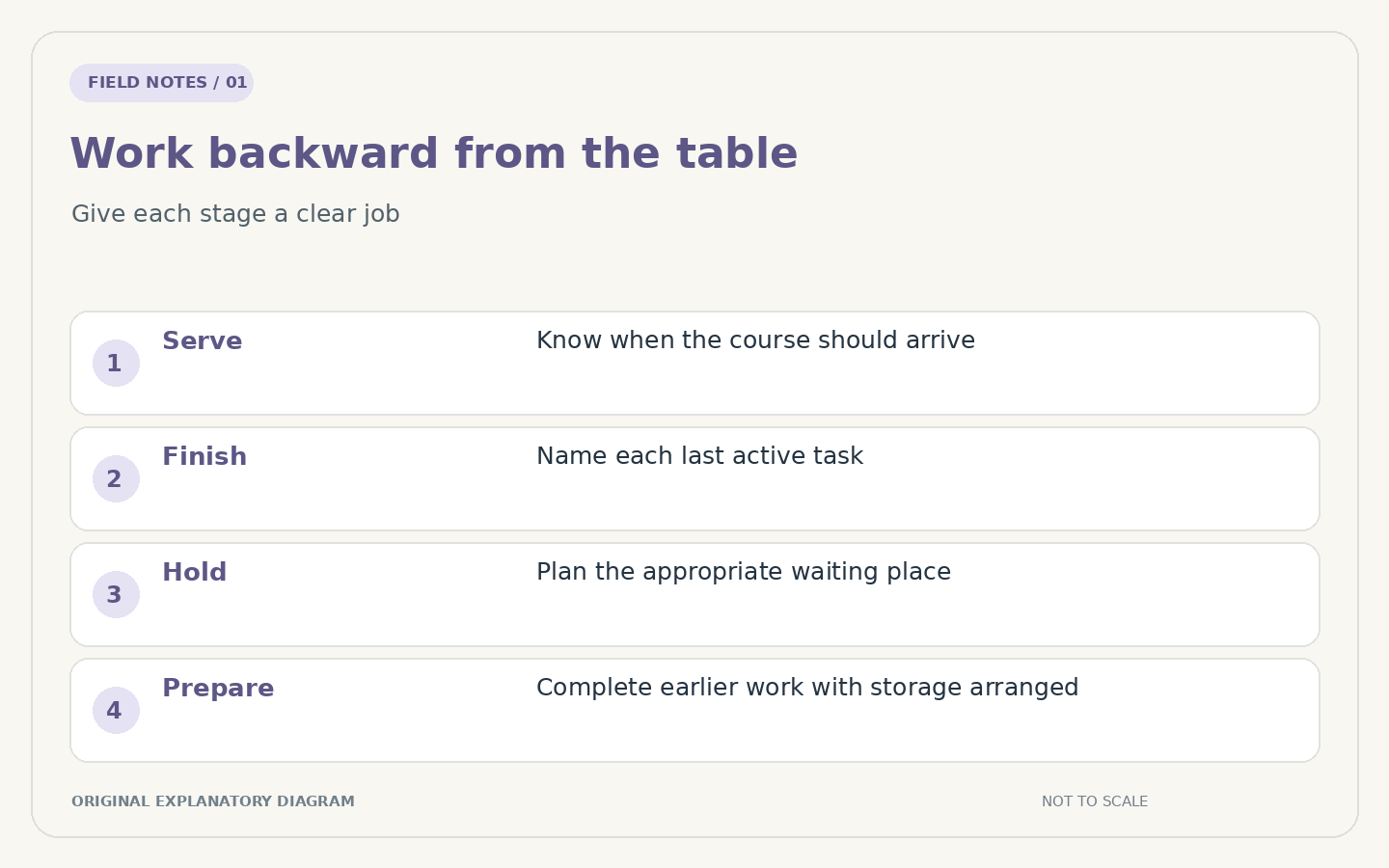
A dinner menu can look beautifully balanced on paper and become impossible when every dish demands attention at once. The sauce needs whisking, the vegetables need draining and the plates are still in the cupboard. Planning backward from the final minutes reveals these collisions before the shopping list is written. It is one of the simplest ways to make a home meal feel considered.
Choose the moment you would like the main course to reach the table. Then ask what must happen immediately before it and what can be completed earlier. This does not require restaurant precision. It requires a realistic account of your kitchen, the people helping and the dishes you can finish comfortably while still enjoying the company.
Give every dish a finishing verb
Write one verb beside each component: roast, reheat, toss, slice, spoon or serve. Add the equipment it needs at that stage. A menu with several dishes marked whisk on the hob has a different workload from one with a roast, a prepared salad and a sauce that can be finished earlier.
The verb should describe the final active job rather than the entire recipe. A dish may involve substantial preparation but little work at service. Another may be quick overall yet demand your complete attention at exactly the wrong moment. This distinction helps you choose combinations that fit together operationally, instead of assuming that several individually easy recipes will make an easy menu.
Count the spaces as well as the minutes
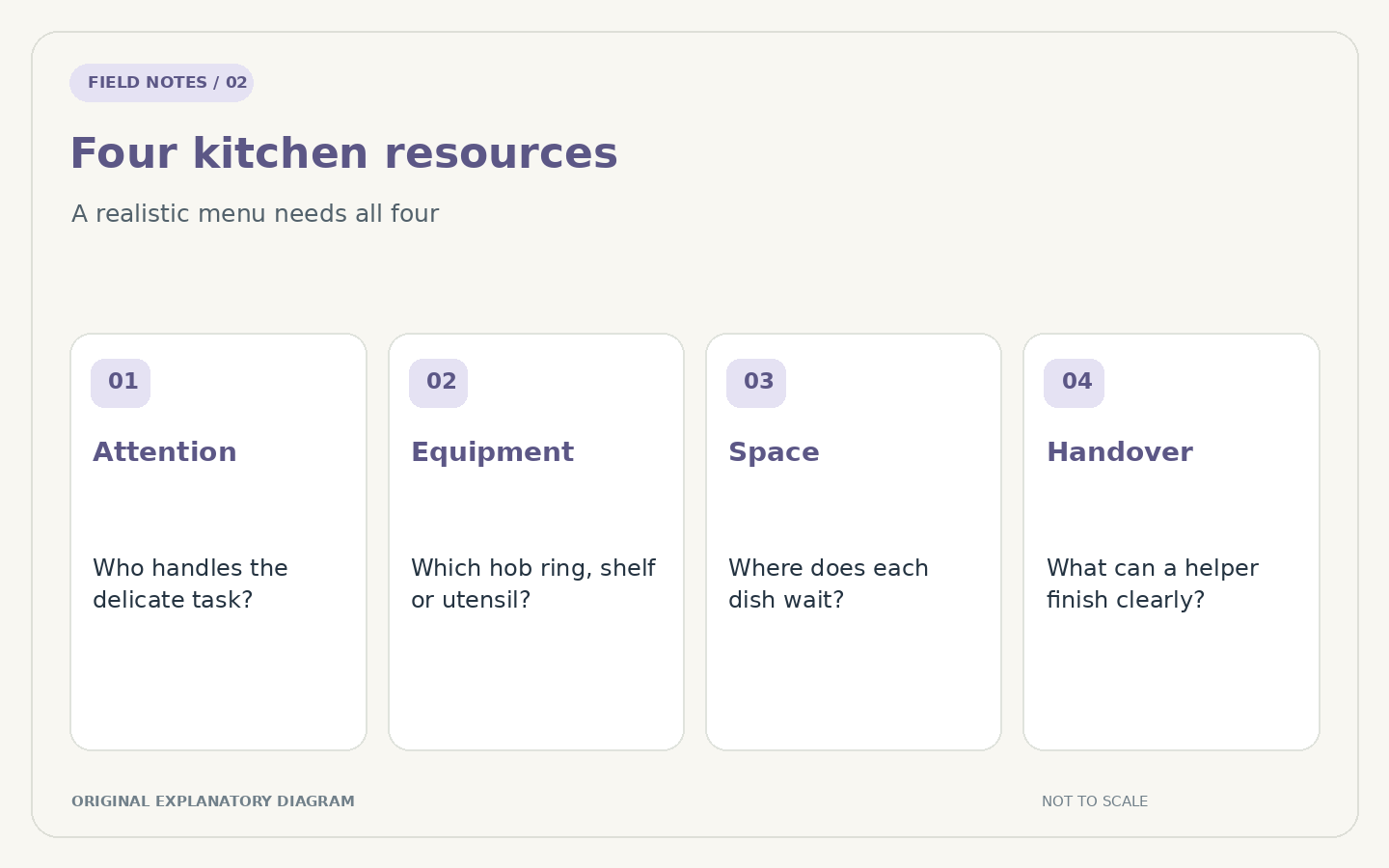
Check oven shelves, hob rings, refrigerator space and the clear area available for plating. A dish cannot wait safely or neatly in space that already belongs to another task. Put serving platters and utensils on the plan too. Discovering that the only large bowl holds the salad when you need it for mixing is an avoidable interruption.
A useful rehearsal is to place empty dishes where they will be used. You can see whether the table has room, whether a hot tray has somewhere secure to land and whether the serving route crosses the busiest cooking area. The exercise takes little time and often suggests a simpler arrangement before any ingredients are committed to the menu.
Choose one dish that needs the spotlight
If a favourite dish requires careful last-minute attention, let the rest of the menu support it. Choose accompaniments whose finishing steps are straightforward and assign them to someone else when appropriate. The aim is to protect the attention that makes the special dish worthwhile, rather than surrounding it with several competing performances.
For a fictional menu, a delicate pan-finished main could be paired with an accompaniment already portioned for reheating and a salad ready to dress. A different menu might make a composed vegetable dish the centre and keep the protein component simple. The principle is flexible: decide which job deserves the final concentration and remove unnecessary work from its path.
Make advance preparation a complete task
Preparing food ahead includes a storage plan. USDA guidance advises prompt refrigeration of leftovers, using shallow containers to help cooling, and generally using refrigerated leftovers within three to four days. It also gives a two-hour limit for leaving perishable food out, shortened to one hour when temperatures exceed 90°F. These limits belong in the plan for advance preparation. [1]
Write a label when you put a prepared component away, including what it is and when it was made. Keep the final recipe instructions with it if another person may finish the dish. A container labelled sauce is less useful than a clear name and a note about its intended course. Advance work is valuable when it reduces later uncertainty as well as later chopping.
Decide where food waits during service
FDA buffet guidance recommends keeping hot foods at 140°F or above and cold foods at 40°F or below, checking with a thermometer and using smaller serving dishes when useful. It advises replacing serving dishes rather than topping up food already on display. These principles help turn a vague idea of keeping things ready into a concrete service arrangement. [2]
For a seated dinner, think about the interval between the first plated portion and the last. For a buffet, think about how replacement dishes will reach the table. Choose the style that fits your equipment and help. A menu should not depend on a holding method you cannot provide, even if that method would be easy in a professional kitchen.
Write instructions another person can follow
Give a helper a bounded job with a clear endpoint. Put these plates here and bring the salad when I say the main is ready is easier to act on than help with serving. If a task needs a recipe-specific temperature or timing check, make that information available rather than expecting the helper to infer it.
Keep the handover friendly and short. A labelled tray with the necessary utensil can communicate more than several shouted instructions. Ask whether the person is comfortable with the task before relying on them for a critical step. Guests who offer help may enjoy carrying dishes while preferring not to manage unfamiliar cooking. A good plan makes room for that difference.
Build in a graceful pause
People arrive late, conversations run long and a dish may take more time than expected. Decide in advance which part of the meal can absorb a delay. That might mean waiting to dress a salad or postponing a finishing step until everyone is ready. A pause is easier when it has a place in the design.
Avoid promising an exact serving minute that your menu cannot reliably meet. Give yourself a practical window and communicate it naturally. If something needs simplifying, remove a garnish or an unnecessary extra component before sacrificing the essential cooking or storage steps. Most guests will remember the meal and the company more clearly than the decorative detail that would have kept the host in the kitchen.
Keep the menu's useful version
After the meal, record the one or two points that actually affected service. Perhaps a platter was too small, a sauce needed more attention than expected or an advance task saved the evening. These notes are more useful for the next dinner than a vague declaration that the menu was a success or a disaster.
Keep the final ten-minute plan with the recipes you want to repeat. Over time it becomes a small collection of menus you understand in your own kitchen. Good entertaining then depends less on improvising under pressure and more on choosing a familiar arrangement of tasks. The food can still be ambitious; the final moments simply have enough structure for you to enjoy serving it.
Sources
- How do I handle leftovers safely? — USDA Food Safety and Inspection Service
- Serving Up Safe Buffets — US Food and Drug Administration